
News List
India’s First Autonomous Electric Cargo Three-Wheeler Hits the Market: What OSM’s New Launch Offers

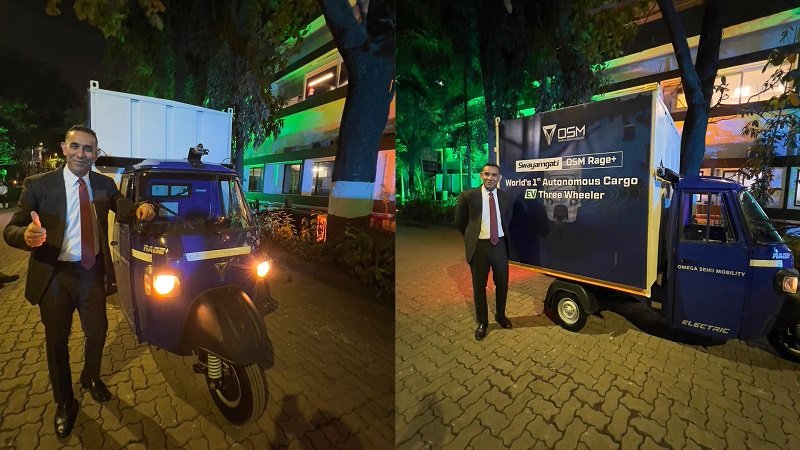
The electric-mobility landscape in India has taken a leap forward with the launch of the Omega Seiki Mobility (OSM) autonomous cargo three-wheeler — the new Swayamgati Cargo. Unveiled in December 2025, this marks the arrival of the country’s first commercially available autonomous electric cargo 3-wheeler, offering a modern solution for logistics in structured, low-speed environments.
What Swayamgati Cargo Brings to the Table
- Affordable autonomous mobility: Swayamgati Cargo comes at an introductory price of ₹ 4.15 lakh — a competitive tag for a self-driving EV.
- Electric & zero emission: Built on OSM’s electric platform, the vehicle supports eco-friendly operations and reduced carbon footprint, aligning with India’s push for cleaner transport.
- Range and speed tuned for logistics: The cargo three-wheeler offers a driving range of up to 120 km per charge and a top speed of 20 km/h — ideal for short-distance intra-campus transport, industrial parks, warehouses, airports or gated communities.
- Autonomous tech stack: Swayamgati Cargo integrates AI-powered navigation, Lidar, GPS, multi-sensor obstacle detection (with detection range ~6 m), and remote fleet-management — enabling driverless movement along pre-mapped routes.
- Use-cases and deployment environment: The vehicle is targeted at structured and semi-controlled environments — airports, industrial hubs, smart campuses, e-commerce warehousing, factory zones and similar setups, where traffic and complexity are manageable.
Why This Launch Matters
With this launch, OSM becomes the first Indian manufacturer to offer a production-ready autonomous cargo EV tailored for real-world logistics needs. The move signals a shift: from electric vehicles as only cost- and emission-saving alternatives to vehicles embedding autonomy and fleet-management intelligence — a step closer to future-ready logistics infrastructure in India.
Moreover, by pricing it at ₹ 4.15 lakh, OSM is making autonomous mobility accessible and scalable, rather than a niche premium offering. This democratization could encourage adoption across smaller businesses, campuses, warehouses and industrial parks, not just big corporations.
OSM’s own ambition is high: reports mention plans to roll out about 1,500 autonomous cargo and passenger units over the next 24 months — potentially seeding dozens of campuses, logistics parks and smart-city projects with driverless cargo mobility.
Important Context & Limitations
- The vehicle is meant for controlled or semi-controlled environments — like campuses, industrial zones or gated spaces — not for India’s chaotic public roads or mixed-traffic city streets.
- It operates on pre-mapped routes; customization is required based on the client’s layout and stop configuration.
- As of launch, regulations for autonomous vehicles in this category remain underdeveloped or non-existent in India.
What This Could Mean for India’s Logistics & EV Future
Swayamgati Cargo is more than a new 3-wheeler — it’s a signal that India is ready to integrate autonomous mobility into practical applications. For logistics-heavy sectors such as warehousing, e-commerce fulfillment, campus operations, manufacturing hubs or airport cargo zones, this could reduce dependence on labour, improve operational efficiency, and lower costs.
Furthermore, as EV technology becomes standard and autonomy becomes affordable, we may see more widespread adoption of such vehicles across smaller cities and towns — democratizing access to clean and intelligent mobility. If the rollout scales up (as OSM plans), India could well become a global player in affordable autonomous EV logistics.
In a country where last-mile delivery, intra-campus transport, and low-speed logistics form a significant chunk of mobility needs — particularly in industrial belts, gated communities and commercial complexes — Swayamgati Cargo arrives as a timely and potentially transformative solution.