
News List
Why Western Countries Have Much More Advanced Trucks Than India

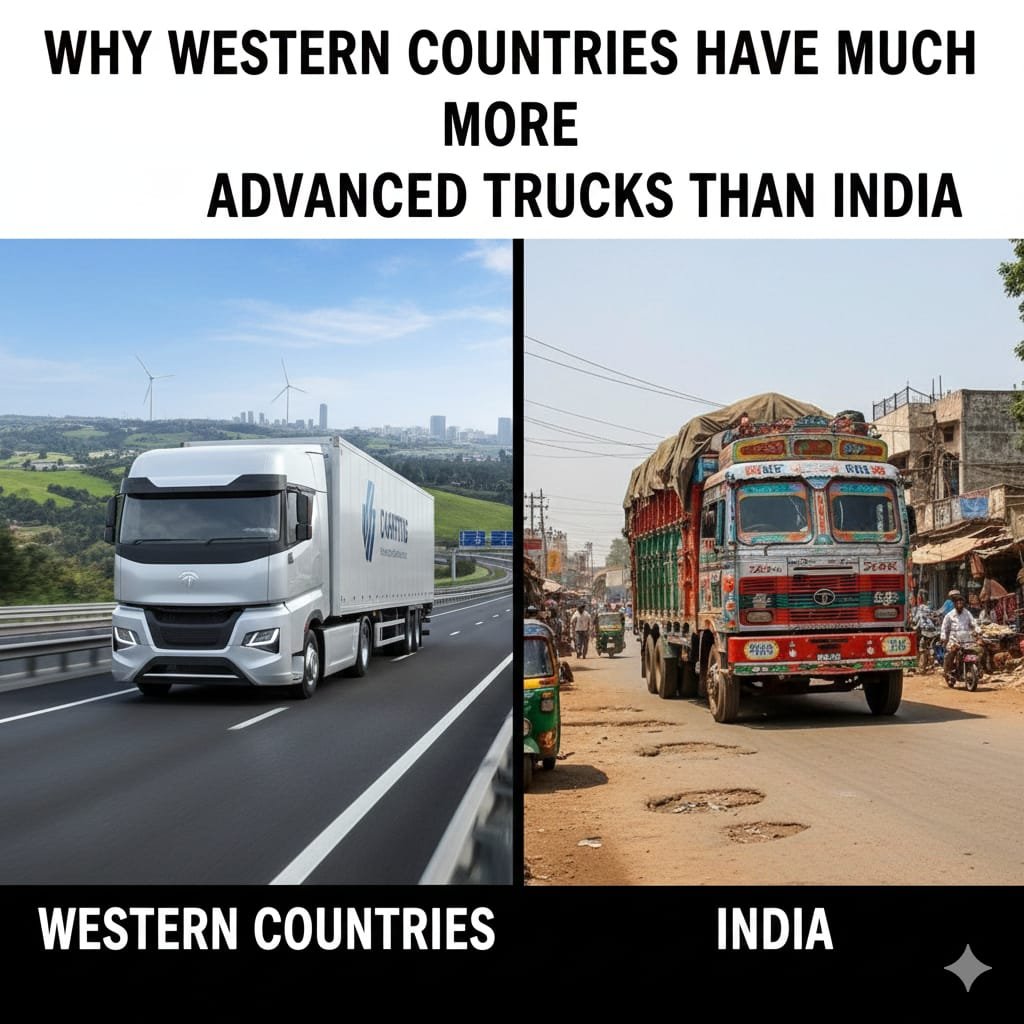
Commercial trucks are the backbone of any nation’s economy, supporting industries, logistics, and long-distance freight movement. But when we compare India’s trucking landscape with that of Western countries—such as the US, Germany, or the UK—the technological gap is immediately visible. From engines to safety systems and cabin comfort to digital integration, Western trucks are significantly more advanced.
Here are the key reasons explaining this difference.
1. Better Road Infrastructure Enables Better Trucks
One of the biggest factors behind advanced trucks in Western countries is high-quality road infrastructure.
In the US and Europe, highways are:
- Wider and smoother
- Designed for heavy, high-speed freight
- Equipped with better signage and safety barriers
- Enforced with strict axle load rules
Advanced trucks—featuring high horsepower, bigger trailers, advanced braking systems, and automated driving tech—perform best on such roads.
India, on the other hand, still has:
- Uneven road quality
- Congestion
- Narrow highways in many regions
- Frequent stops and unpredictable traffic
This forces manufacturers to build trucks that are rugged and low-speed rather than high-tech and feature-heavy.
2. Stricter Safety Regulations Drive Innovation
Western nations follow extremely strict safety standards, which directly influence truck design. These include:
- Mandatory ADAS (Advanced Driver Assistance Systems)
- Collision mitigation technology
- Lane departure warning
- Stability control
- Airbags in cabins
- Strong crash-tested cabin structures
In India, safety norms have improved but are still evolving. Many features remain optional rather than mandatory, slowing down the adoption of high-end safety technologies.
3. Higher Budget and Premium Market Demand
Western buyers—both individuals and companies—are willing to pay more for advanced features because the market prioritises:
- Driver comfort
- Fuel efficiency
- Automation
- Low maintenance
- Sustainability
In India, price sensitivity is very high. Fleet owners prioritise:
- Low initial cost
- Easy repairability
- High load-carrying capability
- Minimal electronics
This leads manufacturers to focus on cost-effective, durable designs rather than premium, feature-rich models.
4. Skilled Workforce and Training Standards
Western countries have structured training programmes for commercial drivers. Drivers are trained in:
- Handling advanced tech
- Safety protocols
- Fuel-efficient driving
- Using autonomous and semi-autonomous systems
In India, the trucking workforce is largely informal. Training schools exist but are limited, and many drivers learn on the job. This makes the introduction of highly advanced features difficult, as the end users may not be trained to operate or maintain them.
5. Better Fuel Quality and Emission Standards
Western countries have stricter emission norms like:
- Euro 6
- EPA 2027 regulations (US)
Their cleaner fuel quality supports advanced engines and after-treatment systems.
India only recently shifted to BS6, equivalent to Euro 6, but fuel adulteration and inconsistent quality in some regions limit the application of ultra-refined engine tech.
6. Strong R&D and Government Support
Governments in the West heavily support:
- Automotive R&D
- Electric truck development
- Hydrogen fuel cell technology
- Autonomous trucking corridors
India is catching up but is still in early stages. Investments in truck technology, EV infrastructure, and automation are growing but have not yet reached Western levels.
7. Logistics Ecosystem Is More Organized
The trucking ecosystem in Western nations is:
- Highly digital
- Efficiently regulated
- Supported by large logistics companies
- Driven by transparent freight systems
India’s logistics industry is improving with FASTag, GPS mandates, and digital freight platforms, but fragmentation and unorganized operations slow the adoption of high-end trucks.
Conclusion
Western countries have more advanced trucks not because India lacks potential, but because the ecosystem, market priorities, and infrastructure differ significantly. As India rapidly invests in highways, logistics modernization, EV adoption, and technology, the gap is narrowing. Over the next decade, Indian trucking is expected to evolve dramatically—with better safety, greater comfort, cleaner engines, and smarter digital systems.