
News List
Is India the Next Commercial Vehicle Export Hub?

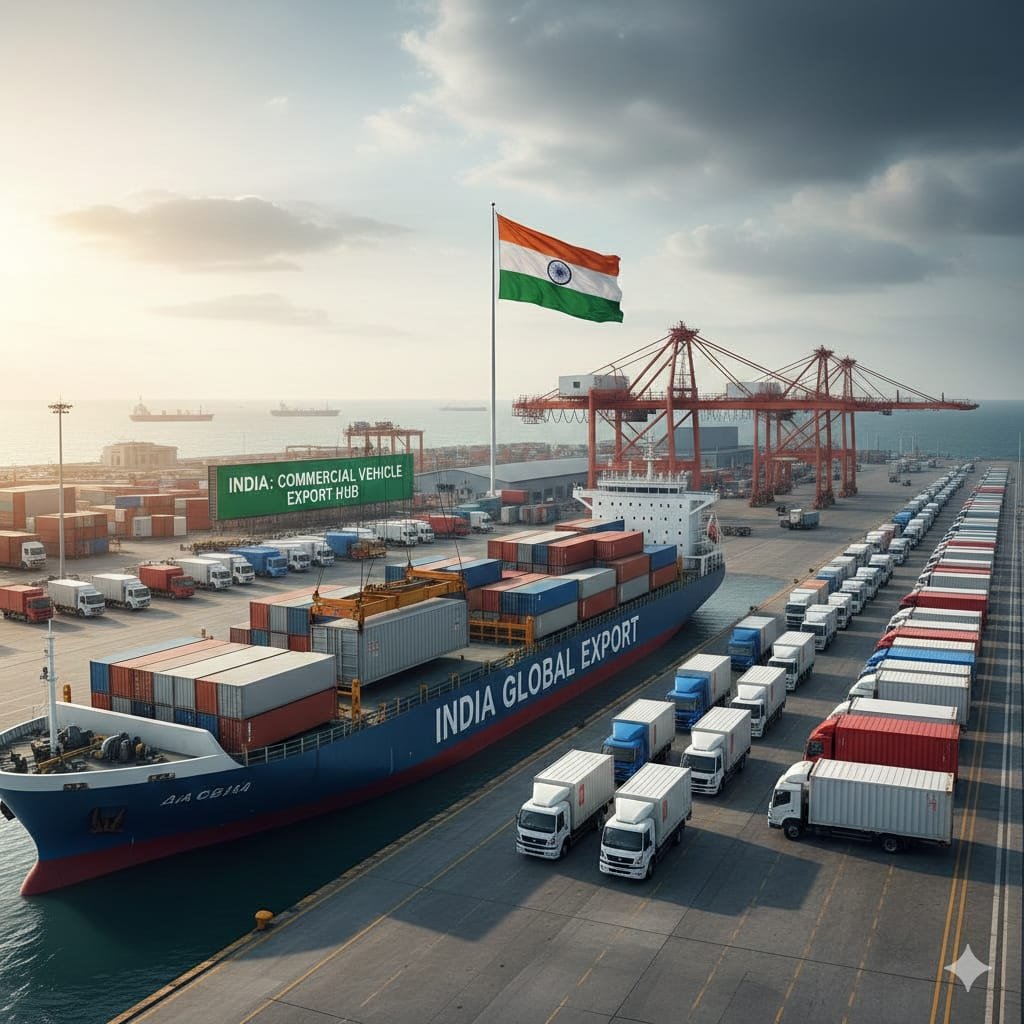
India’s automotive industry has long been one of the world’s largest, but in recent years, the spotlight has shifted to a new opportunity—the rise of India as a global commercial vehicle export hub. With the growth of manufacturing capabilities, cost advantages, and a rapidly modernising ecosystem, India is positioning itself as a strong contender in the global CV export market. The question is no longer if, but how fast India can scale this transformation.
1. Strong Manufacturing Capabilities and Cost Advantage
India’s biggest strength is its ability to produce high-quality commercial vehicles at globally competitive prices.
Brands like Tata Motors, Ashok Leyland, Mahindra, BharatBenz, Eicher, and Maruti Suzuki have built world-class manufacturing facilities that meet international standards.
Key advantages include:
- Lower production and labour costs
- High localisation of parts
- Robust supplier ecosystem
- Mature component manufacturing clusters in Chennai, Pune, Jamshedpur, and Hosur
This allows Indian OEMs to produce trucks, buses, and LCVs at significantly lower costs than Western manufacturers—making them ideal for markets in Asia, Africa, Latin America, and even some European regions.
2. Rising Global Demand for Affordable and Reliable CVs
Many developing countries are looking for:
- Durable vehicles
- Low-maintenance fleets
- Strong load capability
- Cost-effective technology
Indian commercial vehicles fit this demand perfectly. Indian trucks and buses are known for their:
- Ruggedness
- Ease of repair
- Efficient engines
- Adaptability to harsh road conditions
This makes them extremely attractive in export markets that need reliability without the premium price tag.
3. Improving Quality and Technology Standards
India has rapidly upgraded from BS4 to BS6 emission norms, equivalent to Euro 6 standards. This shift has:
- Enhanced engine performance
- Reduced emissions
- Improved global market compatibility
With features like telematics, ADAS-ready platforms, better cabin comfort, enhanced safety features, and improved fuel efficiency, Indian CVs are now meeting global expectations.
Many Indian manufacturers are also investing in electric commercial vehicles, which opens doors to new markets focused on sustainability.
4. Government Support and Export-Friendly Policies
The Indian government is actively pushing the auto sector towards global leadership through:
- Production-Linked Incentive (PLI) schemes
- Faster approvals for export operations
- Simplified norms for component manufacturing
- Support for EV and hydrogen mobility technologies
These initiatives strengthen India’s position as a competitive export base.
5. Strategic Location and Global Connectivity
India’s geographical location is ideal for exporting to:
- Middle East
- Africa
- Southeast Asia
- South Asia
- Eastern Europe
With expanding port infrastructure—Mumbai, Chennai, Mundra, Vizag—logistics for export have become faster and more efficient.
6. Increasing Presence of Global OEMs
Companies like Daimler (BharatBenz), Volvo-Eicher, Scania, Fuso, and MAN have all established manufacturing units in India—not just for domestic sales, but specifically for exports.
For example:
- Daimler uses India as a global production base for its Fuso range.
- Volvo exports buses from India to several Asian and Middle Eastern markets.
- Ashok Leyland exports to over 50+ countries.
This global trust is a major indicator of India’s rising export potential.
Conclusion: A Hub in the Making
India is unquestionably emerging as a major commercial vehicle export hub. With competitive pricing, high manufacturing quality, upgraded emission norms, and strong global demand, the country is entering a new era of automotive leadership.
While infrastructure and further technological advancements will continue to evolve, India’s trajectory is clear—the world is increasingly driving vehicles built in India.