
News List
What EXCON 2025 Means for India’s Heavy-Duty Truck & Bus OEMs: Opportunities Beyond Construction

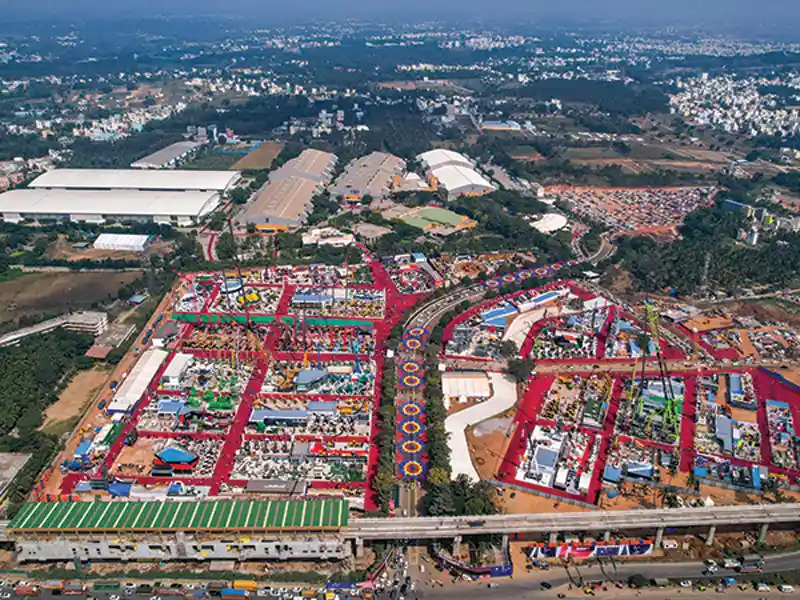
EXCON has long been the heartbeat of India’s construction-equipment ecosystem — and the 13th edition (9–13 December 2025, BIEC Bengaluru) promises to be bigger, louder and more future-facing than ever. With over a thousand exhibitors, large international participation and a government push toward massive infrastructure spend, EXCON 2025 is not just a construction show: it’s a market map for heavy-duty truck and bus OEMs looking to expand into adjacent sectors.
Here are the concrete opportunities OEMs should be reading from the show-floor signals.
- Urban & Mass Transit: buses as a climate and mobility play
City transport authorities and state governments are increasingly prioritising modern, efficient fleets — often electrified or hybrid — to reduce emissions and congestion. OEMs can use EXCON to showcase bus platforms tailored for municipal contracts: modular electric drivetrains, low-floor accessibility, integrated telematics and upgradable battery packs. Positioning buses as part of city-scale mobility solutions (not just vehicles) turns each sale into a multi-year service contract. - Logistics and Intercity Freight: vocational conversions win
The logistics boom (e-commerce, 3PL growth) needs reliable, fuel-efficient heavy-duty carriers and specialised vocational variants — refrigerated, tipper-to-tractor conversions, multi-axle long-haulers. EXCON’s concentration of fleet owners and infrastructure developers is a prime place to market chassis that can be rapidly body-adapted and to demonstrate upfit partnerships. Live demos and product integrations at the show accelerate buyer confidence. - Mining, Ports and Industrial OEMing — lifetime value matters
Beyond on-road construction, heavy trucks serve mining, ports and large industrial sites where uptime and ruggedness are king. OEMs that present integrated solutions — rugged powertrains, local spare-parts networks, predictive telematics for remote sites — can capture higher lifetime value per asset. EXCON’s cross-sector attendee mix gives OEMs direct access to these buyers. - Alternative fuels & electrification: showcase now, scale later
EXCON 2025 is emphasising sustainability and alternate-fuel tech across exhibits and summits. That spotlight allows OEMs to trial hydrogen/EV prototypes, demonstrator buses, and CNG/biogas vocational variants with fleet operators already exploring low-carbon options. Early pilots presented at EXCON can translate into government pilot schemes and state tenders. - Aftermarket, financing & digital services — recurring revenue plays
OEMs often win the tender but lose the aftermarket. EXCON is an ideal platform to bundle financing, telematics subscriptions, driver training and uptime SLAs as packaged propositions. Fleet buyers increasingly choose suppliers who offer predictable total cost of ownership (TCO) rather than lowest upfront price.
How to capitalise at EXCON 2025 (practical moves)
- Stage real demos: run a route simulation or load-test to prove uptime and fuel/battery economics.
- Partner local bodybuilders and finance providers to offer turnkey fleet procurement + service.
- Launch a pilot programme for an EV bus or alternative-fuel truck tied to a state transport or logistics operator.
- Promote telematics-led uptime guarantees to differentiate on TCO.
Bottom line: EXCON 2025 is more than construction machinery on display — it’s a concentrated marketplace for OEMs to reposition heavy trucks and buses as multimodal mobility and industrial-logistics platforms. Those who show up with integrated, service-oriented solutions and clear pilots will turn exhibition buzz into orders across sectors well beyond the construction site.