News List
Chinese & Korean OEMs Eyeing India: How This Affects Domestic Truck & Bus Brands

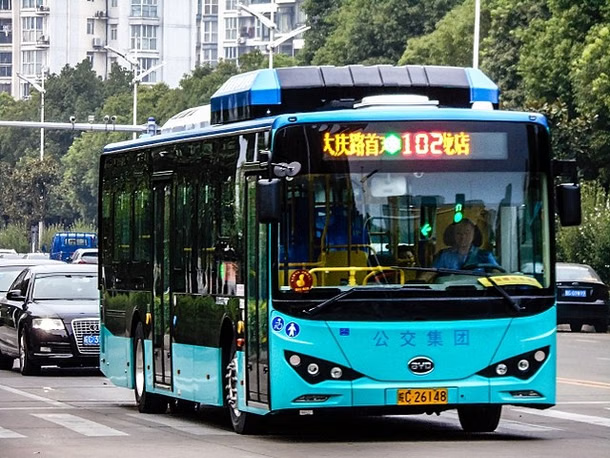
India’s commercial vehicle market is entering a new phase — one shaped by aggressive interest from Chinese and Korean OEMs looking to expand beyond their saturated home markets. With India pushing massive infrastructure upgrades, clean-mobility targets, and logistics modernization, global players see a rare opportunity: a fast-growing, high-volume market ready for disruption.
But what does this mean for India’s established truck and bus manufacturers? The short answer: increased competition, faster innovation cycles, and a reshaping of customer expectations.
Here’s a breakdown of how this global shift could impact domestic brands — and what they need to do to stay ahead.
1. Price Pressure Will Intensify
Chinese OEMs are known for value-focused pricing, thanks to large-scale manufacturing, deep supplier integration, and government-backed industrial ecosystems. Their entry into India could push the market toward:
- More competitively priced mid-segment trucks
- Affordable electric buses and light-duty EV trucks
- Lower-cost spare parts and components
Domestic brands — long used to price-sensitive buyers — will face direct pressure to optimise cost structures without compromising reliability.
2. Faster EV Adoption in Commercial Mobility
Korean and Chinese OEMs are global leaders in battery tech, EV drivetrains, power electronics and charging systems. Their presence in India could speed up electrification in:
- City buses
- Staff transport
- Last-mile and mid-mile trucks
- Light-duty logistics vehicles
This means domestic brands must accelerate EV product development, expand local cell partnerships, and build strong charging and service ecosystems to stay competitive.
3. Technology Upgrades Will Become Non-Negotiable
Chinese and Korean players typically enter markets with feature-heavy commercial vehicles — advanced ADAS, smart dashboards, connected telematics and efficient powertrains.
Their arrival will raise customer expectations around:
- Driver comfort and safety
- Infotainment and connectivity
- Real-time fleet management
- Digital service platforms
Indian OEMs will need to refresh cabin ergonomics, upgrade digital tech, and integrate intelligent fleet solutions at a faster pace.
4. Local Partnerships Will Reshape the Ecosystem
Foreign OEMs rarely enter a market alone. Many explore:
- Joint ventures with component makers
- Assembly partnerships with Indian manufacturers
- Technology-transfer deals
- Local battery-pack manufacturing
- Shared dealer networks
Such partnerships may create new supply chain efficiencies that challenge legacy players. In response, domestic OEMs might also form alliances — especially in batteries, EV components, software and telematics.
5. Domestic Brands Will Need to Double Down on After-Sales Strength
If there’s one area where Indian OEMs dominate, it’s after-sales reach.
Their dense service networks, deep rural penetration, and decades-long relationships with fleet operators form a massive competitive moat.
Foreign OEMs entering India often struggle with:
- Slow parts availability
- Limited service coverage
- High maintenance costs
- Lower trust among fleet owners
Indian brands must leverage this advantage with:
- Faster service times
- Predictive maintenance through telematics
- Uptime-based service contracts
- EV-ready technician training
The strongest differentiator in the next decade will not be vehicle specs — it will be service quality and uptime.
6. Fleet Operators Will Benefit the Most
The biggest winners of global competition are Indian buyers. More players in the market translate to:
- Better vehicle options
- More financing choices
- Faster technology upgrades
- Improved TCO (Total Cost of Ownership)
- Stronger warranties and service plans
Foreign OEMs will push domestic brands to innovate, while Indian players will continue leveraging their deep-rooted market understanding.
Final Word
The entry of Chinese and Korean OEMs into India’s truck and bus market is inevitable — and their impact will be significant.
But this doesn’t spell trouble for domestic brands; instead, it marks the beginning of a more competitive, innovation-driven era.
Indian OEMs that focus on electrification, digital services, cost optimisation and robust after-sales will not just withstand global competition — they will expand their leadership. The market is evolving, and the brands that adapt fastest will own the next decade of commercial mobility in India.