
News List
Daimler Truck Begins Second Phase GenH2 Testing

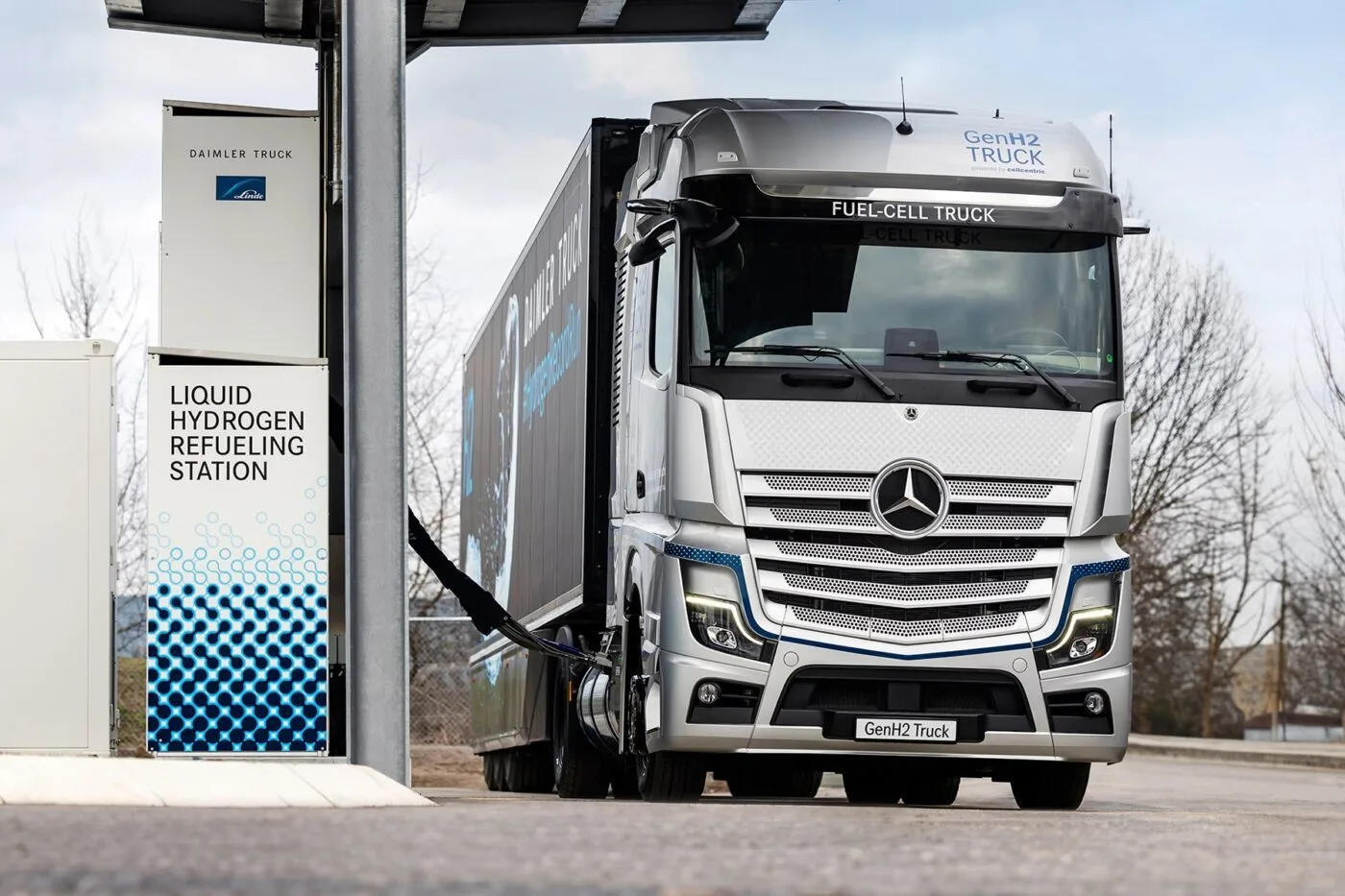
Daimler Truck has moved its hydrogen-powered Mercedes-Benz GenH2 Truck into a new stage of development, beginning a full year of customer testing with five major logistics partners across Germany. The second phase of trials, which officially started as planned this month, marks a shift from earlier “customer-oriented” testing to real fleet operations with increasingly demanding requirements.
The participating companies—Hornbach, Reber Logistik, Teva Germany, Rhenus and DHL Supply Chain—will each operate one GenH2 Truck on their standard routes. Daimler Truck says the feedback from these day-to-day logistics operations will be incorporated directly into the truck’s engineering refinements as well as preparations for future sales, service, and support structures. The trucks will be tested across various applications, including long-distance transport, temperature-controlled pharmaceutical cargo, and general freight.
This next step comes after initial trials launched in mid-2024 with partners such as Air Products, Amazon, Holcim, Ineos and Wiedmann & Winz. Those early tests covered 225,000 kilometres in total, with hydrogen consumption ranging from 5.6 to 8.0 kilograms per 100 kilometres depending on load and route conditions.
The GenH2 Truck is powered by two fuel cell units from Cellcentric, a joint venture between Daimler Truck and Volvo Group. Together, they deliver 300 kW of continuous power (2 × 150 kW). A 70 kWh battery provides an additional 400 kW during peak demands like acceleration and hill climbs. The pre-series electric motors offer 2 × 230 kW continuous output and up to 2 × 330 kW maximum power, producing torque of up to 2 × 2,071 Nm. Daimler Truck highlights the cooling and heating system as a central component, ensuring the fuel cell and battery systems operate at optimal temperatures to enhance durability.
Weighing around 40 tonnes with a payload of roughly 25 tonnes, the GenH2 Truck runs on liquid hydrogen (sLH2). This gives it a major advantage in range—over 1,000 kilometres per refuelling, as demonstrated during a 1,047-kilometre long-distance test the company conducted in 2023. However, the use of sLH2 means refuelling infrastructure remains a major constraint. Currently, the trucks can only be refuelled at two specialised Linde-operated filling stations in Wörth am Rhein and near Duisburg.
Despite these challenges, Daimler Truck is pushing ahead with development. The company has already begun work on the next generation of the vehicle and plans to build a small series of 100 GenH2 tractors at its Wörth plant starting at the end of 2026. Full-scale series production, originally targeted for 2027, has now been pushed to the early 2030s due to slow growth in hydrogen infrastructure and expected lower deployment volumes.
For now, the company continues to pursue its dual strategy of hydrogen and battery-electric trucks in Europe, while adjusting its approach in other markets. The latest phase of testing is expected to play a key role in shaping how hydrogen-powered long-haul transport evolves in the coming decade.