
News List
Govt Plans to Move ₹4,891 Cr E-Truck, E-Bus Push to 2026

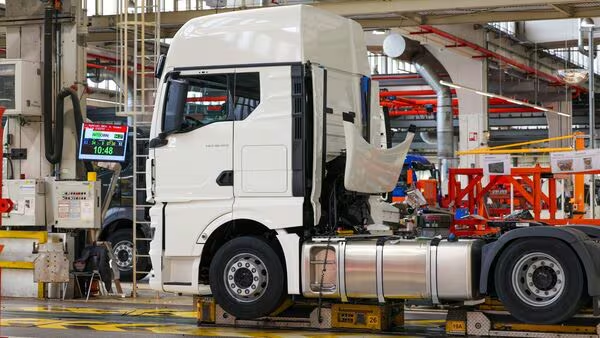
The Ministry of Heavy Industries (MHI) has requested the finance ministry to roll over a major chunk of funds earmarked for promoting electric trucks and electric buses under the PM E-Drive scheme to the next fiscal year. According to people familiar with the matter, the ministry has been unable to disburse any of the planned incentives so far due to delays in localisation clearances and ongoing supply chain disruptions.
The PM E-Drive programme — launched to accelerate the adoption of electric commercial vehicles — initially allocated ₹4,391 crore for e-buses and ₹500 crore for e-trucks. The two-year scheme, covering FY24 to FY26, aimed to deploy over 14,000 electric buses and 5,643 electric trucks across the country by March 2026. However, with no models receiving government approval yet, the entire ₹4,891-crore outlay remains untouched.
Sources said the ministry completed its internal budget discussions with the finance ministry in October. During these consultations, MHI proposed shifting the current year’s allocation into the next financial year to reflect ground realities and revised disbursal timelines. A senior official aware of the matter noted that actual payouts are now expected only in FY27, prompting the need for re-mapping the budget under revised estimates.
Industry insiders attribute the delay to two major bottlenecks. First, electric truck manufacturers are still awaiting approval of component localisation norms — a mandatory requirement under India’s phased manufacturing programme. Without these approvals, companies cannot qualify for incentives. Second, the much-anticipated tender for e-buses has been pushed back, preventing state transport undertakings and private operators from placing large-scale orders.
In light of these setbacks, the government has quietly extended the PM E-Drive scheme by two additional years, now running through FY28. Officials say the extension is intended to give manufacturers and suppliers more time to meet localisation targets, iron out supply chain issues, and participate in fresh tenders.
Although the scheme has generated strong interest from vehicle manufacturers and fleet operators, the lack of approvals has halted progress on the ground. Companies seeking to enter the electric heavy-vehicle segment argue that establishing local supply chains for key components — especially advanced battery packs, drivetrains, and high-voltage architecture — requires longer lead times and clearer policy direction.
Despite the delays, the government remains committed to its broader electrification goals, especially in the commercial transport segment, which accounts for a significant share of India’s fuel consumption and emissions. The ministry is hopeful that the restructured budget timeline and extended window will allow the sector to stabilise and accelerate deployment over the next two to three years.
For now, however, the ambitious plan to roll out thousands of e-buses and e-trucks by FY26 stands on pause — with the entire incentive corpus awaiting approval for transfer to the next fiscal cycle.