
News List
Bajaj Auto Charts a Multi-Fuel Path to Secure Three-Wheeler Leadership

As India’s streets evolve with the country’s growing appetite for cleaner mobility, Bajaj Auto is taking a calculated yet confident step into the future of urban transport. Known for its ubiquitous three-wheelers that have long been an integral part of India’s transport fabric, the company is reimagining its business model to stay ahead in an era increasingly defined by sustainability and technological transition.
For decades, Bajaj Auto’s RE series has dominated India’s three-wheeler market — a category that remains vital for urban commuting and last-mile connectivity. But as the mobility sector transitions toward alternative fuels, the company’s leadership believes that success will depend not on a sudden switch but on a balanced, multi-fuel approach.
At its Pune headquarters, Rakesh Sharma, Executive Director of Bajaj Auto, and his team are steering a strategy built on pragmatism. Rather than rushing into full electrification, Bajaj is anchoring its roadmap around compressed natural gas (CNG) — currently one of the most cost-efficient and cleaner fuels available — while scaling up its electric offerings in line with market readiness and infrastructure development.
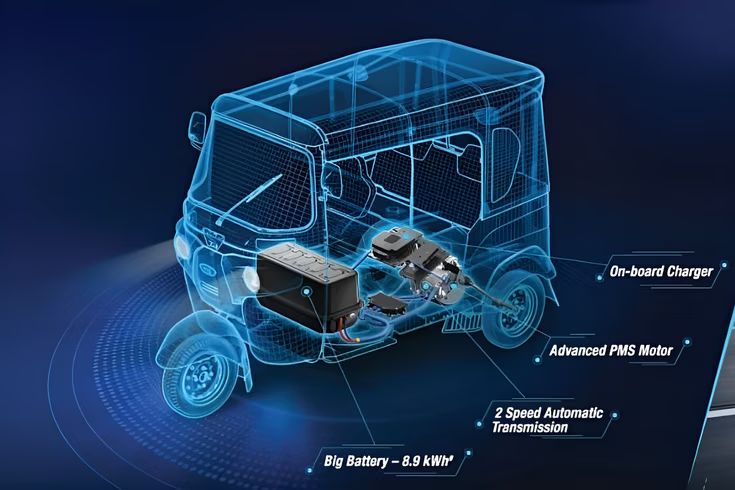
Central to this vision is the Bajaj RE E-TEC 9.0, the company’s latest electric three-wheeler model, designed to cater to both passenger and cargo applications. Combining Bajaj’s proven reliability with electric innovation, the E-TEC 9.0 represents the brand’s effort to bridge the gap between traditional internal combustion engines and the growing demand for zero-emission vehicles.
Sharma notes that the CNG segment remains strong, particularly in states where gas refuelling networks are expanding rapidly. Bajaj plans to retain CNG as a core pillar of its three-wheeler portfolio even as it diversifies into battery-powered vehicles. “Our strategy is about being future-ready, not future-reckless,” Sharma is quoted as saying at internal strategy meetings, underscoring the company’s cautious optimism.
This hybrid path allows Bajaj Auto to adapt to varying regional needs — where infrastructure, energy policies, and consumer behaviour differ significantly across India. Cities with mature CNG ecosystems will continue to see growth in gas-powered vehicles, while urban centres pushing for electrification will find Bajaj’s EVs ready for deployment.
Analysts view this as a future-proof strategy that balances sustainability with financial prudence. By not abandoning profitable legacy models too quickly, Bajaj can leverage existing cash flows to fund its EV transition — a challenge that has strained many automakers globally.
As India accelerates toward a cleaner mobility ecosystem, Bajaj Auto’s multi-fuel roadmap signals a measured evolution rather than disruption — one that could ensure the brand remains the face of Indian three-wheelers for years to come.